IWF: The International Weightlifting Federation
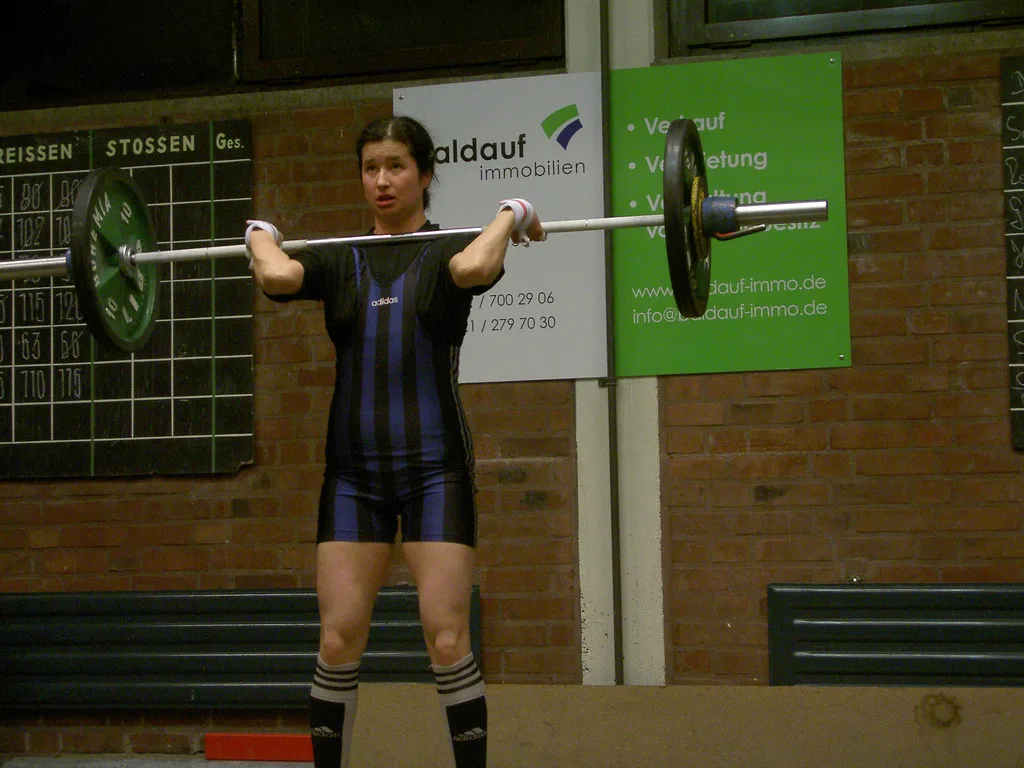
The IWF governs international Olympic weightlifting, where the snatch and clean and jerk define the total. Source: Wikimedia Commons.

Olympic weightlifting is the cleanest-looking strength sport on the platform: one athlete, one barbell, two lifts, three attempts each.
The institution behind it is not that simple.
The International Weightlifting Federation, or IWF, governs the sport that appears at the Olympic Games as weightlifting: the snatch, the clean & jerk, bodyweight categories, world records, world championships, technical rules, Olympic qualification, and anti-doping structures. It is also the federation that came close enough to losing Olympic status that the IOC forced a cultural reset.
That makes IWF history different from ordinary federation history. The sport is old, technically beautiful, and central to Olympic strength culture. The federation also carries the burden of corruption findings, doping scandals, reduced Olympic quotas, and years of external pressure from the IOC, WADA, and the International Testing Agency.
This article explains what the IWF is, how Olympic weightlifting became a two-lift sport, why the press disappeared, what the 2020 crisis changed, how the IWF/ITA anti-doping system works now, what LA28 qualification looks like, and how to read an IWF result without confusing it with powerlifting, strongman, or gym lifting.
For the sport-level article, read Olympic Weightlifting. For the closest strength-sport comparison, see Powerlifting, Powerlifting History, and IPF.
The IWF in one sentence
The IWF is the IOC-recognized international federation that governs Olympic weightlifting: the snatch and clean & jerk performed under standardized rules, bodyweight categories, world championships, records, anti-doping obligations, and Olympic qualification.
The short version:
- Founded: the IWF traces its foundation to June 10, 1905, in Duisburg, Germany.
- Original scope: the first body governed weightlifting and wrestling under the name Amateur Athletic World Union.
- Modern role: the IWF is the world controlling body for weightlifting and is recognized by the IOC as the sole controlling body for international weightlifting.
- Current Olympic lifts: snatch and clean & jerk.
- Old Olympic lift removed: the press was abolished from IWF and Olympic competition after the 1972 Munich Games.
- Anti-doping system: the IWF partnership with the International Testing Agency began in 2018, expanded in 2019, and now covers risk assessment, testing, TUE management, Athlete Biological Passport management, results management, sample storage, re-analysis, and education.
- Current president: Mohammed Jalood was elected IWF president in June 2022 and re-elected in May 2025 for the 2025-2029 term.
- LA28 status: weightlifting has been confirmed for the Los Angeles 2028 Olympic Games; the approved qualification system uses 120 athletes across 12 bodyweight categories.
The useful mental model is this: the IWF is both a sport-rule body and an Olympic-risk management project. It must govern a technical strength sport and continuously prove that the sport belongs in the Olympic programme.
Why the IWF had to exist
Weightlifting existed before the IWF. Strongmen lifted barbells, dumbbells, stones, and awkward objects long before international sport had clean categories or standard rulebooks. Early Olympic Games also included weightlifting before the sport had the modern IWF structure.
But a global sport cannot rely on local definitions of strength. If one country rewards one-hand lifts, another rewards two-hand lifts, and another judges a lift by different technical standards, records do not travel. A world championship needs common rules.
The IWF's own 120-year history material says the 1905 gathering in Duisburg had practical goals:
- standardize names, execution, and evaluation of exercises;
- hold competitions under standardized regulations;
- accept only affiliated members in those competitions;
- observe amateur rules;
- fix prize values;
- unify record rules.
That list sounds administrative, but it is the heart of federation building. A lift becomes a sport result only when the rules say what counts.
The official IWF anniversary account says 11 countries were invited to the 1905 meeting, but only Denmark, Germany, Italy, and the Netherlands were present. The first organization governed both weightlifting and wrestling. In 1920, weightlifting became the only sport governed by the federation. In 1972, the definitive English name International Weightlifting Federation was adopted.
That long institutional evolution explains why old dates can look confusing. The IWF now treats 1905 as its foundation date, but for parts of the 20th century 1920 was often treated as the practical starting point for the weightlifting-only federation.
Olympic weightlifting is not powerlifting
This distinction matters because the website covers both sports.
Olympic weightlifting consists of two lifts:
- Snatch: the barbell moves from the floor to overhead in one continuous movement.
- Clean & jerk: the barbell moves from the floor to the shoulders, then from the shoulders to overhead.
Powerlifting consists of three different lifts:
- Squat.
- Bench press.
- Deadlift.
The sports reward different qualities. Weightlifting is more explosive and technically constrained by receiving positions, overhead stability, bar speed, timing, and mobility. Powerlifting is more about maximal force in slower lifts. A good deadlifter is not automatically a good cleaner. A strong overhead press does not automatically produce a good jerk. The barbell is the shared tool; the sport logic is different.
The IWF governs the Olympic version: snatch, clean & jerk, totals, records, bodyweight classes, technical rules, and the international pathway to World Championships and the Olympic Games.
How the sport became two lifts
Modern lifters treat the snatch and clean & jerk as obvious. Historically, the programme changed.
For much of the Olympic weightlifting era, the sport included the press. From the 1928 Amsterdam Olympics through the 1972 Munich Olympics, the Olympic programme used three lifts:
- Press.
- Snatch.
- Clean & jerk.
The press was supposed to be a strict overhead lift from the shoulders. In practice, technique drifted. As weights increased, lifters used more layback, more body movement, and more borderline judging. The lift became hard to police consistently.
The IWF's 2025 retrospective on the end of the press describes years of debate. A proposal to abolish the press was rejected at the 1964 Congress in Tokyo, then rejected again in Mexico City in 1968. In Munich in 1972, the argument finally passed, with the IWF citing judging difficulty and medical advice about injury risk from exaggerated lower-back arching.
From 1973 onward, international IWF competition used only the snatch and clean & jerk.
This is a useful reminder for every strength sport: rules change when a lift becomes impossible to judge. The press was not removed because overhead strength stopped mattering. It was removed because the competition version stopped producing a reliable technical standard.
What an IWF total means
An IWF result is a total:
best successful snatch + best successful clean & jerk = total.
Each athlete gets three snatch attempts and three clean & jerk attempts. The best successful lift in each movement counts. If an athlete bombs out in the snatch, they do not post a total. If they makes a snatch but bombs out in the clean & jerk, they also do not post a total.
That makes attempt selection different from casual gym lifting. A lifter is not only trying to hit the heaviest number possible. They are trying to build a total under pressure.
The practical labels matter:
- sex;
- bodyweight category;
- age category;
- meet level;
- date;
- snatch;
- clean & jerk;
- total;
- whether the result is a world record, continental record, national record, or only a meet result.
A 160 kg snatch and 200 kg clean & jerk are not just "360 kg lifted." They are two technically distinct achievements that combine into a total. The snatch tells you something about speed, receiving ability, and overhead position. The clean & jerk tells you something about pulling strength, front squat strength, jerk mechanics, and overhead stability under fatigue.
Bodyweight categories keep changing
Weightlifting categories change more often than many fans expect.
The IWF history page lists major category changes across eras, including new bodyweight categories in 2018 and later Olympic reductions. The Olympic programme has also been compressed under IOC quota pressure.
Paris 2024 used 10 Olympic medal events: five for men and five for women. The IWF's Paris qualification material set the Olympic athlete quota at 120 lifters. The confirmed Paris list had 120 qualified athletes plus two athletes from the IOC Refugee Team.
LA28 has already changed again. In April 2025, the IWF acknowledged an IOC decision keeping weightlifting at 120 athletes and initially 10 bodyweight categories. In September 2025, the IOC approved two additional bodyweight categories, leaving the athlete quota unchanged but expanding the programme to 12 categories: six for men and six for women. In February 2026, the IWF announced that the LA28 qualification system had been approved: 120 lifters, 60 men and 60 women, across 12 bodyweight categories.
This is one reason old records need context. A record in an old category may not map perfectly to a current Olympic category. A world championship category may not always be an Olympic category. A total should always be read with its weight class and date.
The doping problem was not cosmetic
Weightlifting has had one of the hardest anti-doping histories in Olympic sport.
The problem is not only that some athletes tested positive. It is that the sport's record structure, national-team incentives, and federation governance all came under pressure. When medals are reallocated years later after stored-sample reanalysis, the platform result, medal ceremony, athlete career, and public memory all become unstable.
That is why the 2020 crisis mattered so much.
In January 2020, ARD's reporting raised allegations about corruption, financial irregularities, and doping cover-ups in the IWF. Long-time IWF president Tamás Aján resigned his IOC honorary membership in March 2020 while denying the allegations. On April 15, 2020, the IWF Executive Board accepted his resignation as IWF president after 43 years of service to weightlifting.
The independent McLaren investigation followed. The IWF's own June 2020 statement said McLaren's report revealed a number of instances where IWF governance fell well short of what athletes, member federations, fans, and the sport deserved. The report and evidence were shared with the IOC, WADA, the ITA, ASOIF, and GAISF, and the ITA was empowered to investigate potential anti-doping rule violations.
That crisis changed the sport's relationship with the Olympic movement. Weightlifting was no longer being judged only as a sport. It was being judged as a governance risk.
What the ITA partnership changed
The IWF partnership with the International Testing Agency is central to the federation's survival story.
The IWF announced in November 2018 that it had signed a partnership with the ITA, with work beginning on January 1, 2019. The first scope included risk assessment, test distribution planning and management, out-of-competition testing, TUE management, and education support. In 2019, the partnership expanded to include in-competition testing, Athlete Biological Passport management, results management, long-term storage, and re-analysis of samples.
The current IWF anti-doping page says the ITA is responsible for key areas of the anti-doping programme:
- detailed risk assessment;
- test distribution planning and management;
- in-competition testing;
- out-of-competition testing;
- Therapeutic Use Exemption management;
- Athlete Biological Passport management;
- results management;
- long-term sample storage and re-analysis;
- education support.
That is a major structural change because the federation no longer presents itself as internally controlling the most sensitive anti-doping functions. The IOC's LA28 decision also depended on this direction: weightlifting's inclusion was linked to delegating anti-doping management to the ITA and sanctioning to the Court of Arbitration for Sport at least until the end of 2028.
The result is not proof that every lifter is clean. No testing system proves that. But it is a different governance model from the old one, and that difference is why weightlifting stayed alive in the Olympic programme.
The LA28 status: saved, but watched
Weightlifting was confirmed for the Los Angeles 2028 Olympic Games on October 16, 2023, after a vote at the IOC Session in Mumbai.
That confirmation matters because weightlifting had previously been left in a conditional position. LA28 and IOC communications made clear that weightlifting's status depended on reform: governance, anti-doping independence, and cultural change.
The current LA28 pathway is known:
- 120 total athletes.
- 60 men and 60 women.
- 12 bodyweight categories: six for men and six for women.
- 108 quota places through qualification routes, including ranking and continental representation.
- six host country places.
- six universality places.
- qualification running from July 27, 2026 through May 7, 2028.
This is a survival victory, not a blank cheque. The IWF's future Olympic security depends on continuing to show that governance and anti-doping changes are real. The sport got back into LA28 because it changed enough to satisfy the IOC. It stays safe only if the changes hold.
Governance after 2022
Mohammed Jalood was elected IWF president in June 2022 in Tirana, Albania. The IWF described the election as a renewal: 12 new members joined the Executive Board, female representation increased above the quota, and three athlete representative positions with full voting rights became part of the board.
In May 2025, Jalood was re-elected for the 2025-2029 term. The IWF's own 2025 retrospective says the post-2022 reform period included a new Constitution and By-Laws, clearer procedures, gender equity, athlete representation, term limits, a code of conduct, a refugee team, a gender identity policy, sustainability work, safeguarding policies, and a human rights and non-discrimination policy.
Readers should treat that language as the federation's own account of reform. The more useful question is practical:
- Are anti-doping functions still independent?
- Are sanctions handled outside federation politics?
- Are financial and governance processes more transparent?
- Do athletes have real representation?
- Are national federations held responsible when doping patterns appear?
- Does the IOC continue to accept the IWF's progress?
Those questions matter more than slogans about change.
What choosing the IWF pathway means for an athlete
For an athlete, the IWF pathway is not simply "do Olympic lifts."
It means entering a national federation system that connects to continental championships, IWF events, Olympic Qualification Ranking rules, whereabouts obligations at higher levels, anti-doping education, and technical rules that leave little room for local interpretation.
Choose the IWF pathway if you value:
- the Olympic version of weightlifting;
- the snatch and clean & jerk as the only competition lifts;
- international categories and ranking systems;
- national-team selection and continental/world championship pathways;
- the possibility of Olympic qualification;
- anti-doping oversight through the ITA;
- records and totals that sit inside a globally recognized federation system.
The trade-offs are real:
- categories change when the IWF or IOC changes the programme;
- Olympic quotas are limited and politically important;
- anti-doping obligations can affect supplements, medication, whereabouts, and event eligibility;
- a national federation may be sanctioned for wider patterns, not only individual cases;
- the technical learning curve is steeper than in most strength sports;
- an athlete's best world-category fit may not be an Olympic category in a given cycle.
The decision heuristic is simple: if your goal is Olympic-style weightlifting, the IWF pathway is the pathway. If your goal is general strength, powerlifting, strongman, or gym performance, the IWF system is not the right comparison frame.
How to read IWF records
An IWF record should always be read with:
- Sex.
- Bodyweight category.
- Age category.
- Snatch, clean & jerk, or total.
- Meet and date.
- Whether the category is current, historical, Olympic, or non-Olympic.
- Whether the record was set before or after a bodyweight-category reset.
This prevents common mistakes. A record in a discontinued category is still a record, but it is not directly equivalent to a current Olympic category. A world championship total may occur in a category that is not on the Olympic programme. A huge clean & jerk without a total has a different meaning from a complete competition result.
The most useful ordinary comparison is not a world record table. It is a structured standard or distribution. Use Olympic Weightlifting to understand the lift standards on this site, and use IWF records as elite endpoints, not as everyday programming targets.
Where the IWF fits in strength sports
The IWF is the Olympic lane of barbell strength.
It is more technical than powerlifting, more standardized than most independent strength federations, and more exposed to Olympic governance pressure than almost any other strength sport. Its lifts are fast, precise, and unforgiving. Its politics are heavy because Olympic status brings money, visibility, and scrutiny.
The federation's modern story is not just "old sport with scandals." It is a case study in what happens when a federation nearly loses the Olympic platform and has to rebuild under external pressure.
The IWF remains central because Olympic weightlifting remains central. The snatch and clean & jerk are still among the clearest tests of explosive barbell skill. But every modern IWF result now sits inside a second story: the sport has to keep proving that the institution behind the platform is as serious as the athletes on it.
Where to go next
- For the sport itself, read Olympic Weightlifting.
- For the closest barbell-strength comparison, read Powerlifting.
- For federation history and splits in another strength sport, read Powerlifting History.
- For a stricter powerlifting federation comparison, read IPF.
- For lift-specific strength guides, use the squat, bench press, and deadlift articles.