The Bench Press: A Practical and Historical Guide
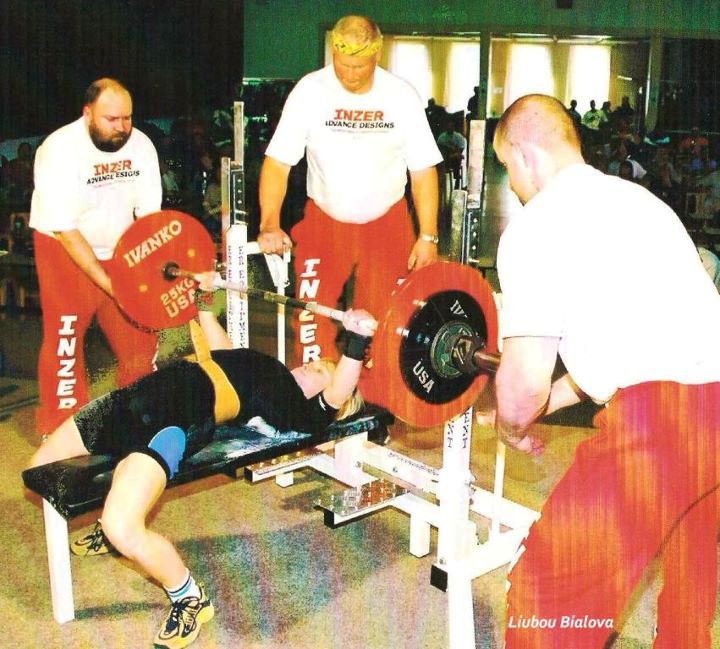
Liubou Bialova at an IPF World Single Bench Press Championship. Photo by Hadson2014, Wikimedia Commons, CC BY-SA 4.0.

Lie down, unrack, lower to chest, press up. Four steps, and yet the bench press is the lift the entire civilian world uses as the proxy for "how strong are you." It is the lift everyone in the gym wants to know your number on, the lift specialist meets exist for, and the lift biomechanics rewards more for skill and proportion than almost any other barbell movement.
This guide covers what the bench press actually is, how it went from a floor exercise to a competition lift in roughly forty years, why technique looks so different between a casual gym presser and an IPF national-team lifter, how to program it, and what the standards used in competition mean.
If you want to compare your own bench against real competing lifters, the strength percentile calculator on the homepage uses the OpenPowerlifting dataset and gives you a percentile by sex, bodyweight, and equipment. The rest of this article will keep referencing "an intermediate bench" or "an elite bench" and those are otherwise abstract.
What a bench press actually is
A bench press is a horizontal pressing movement: a loaded bar moves vertically under gravity while the lifter, lying supine on a bench, decelerates it down to chest contact and accelerates it back up to lockout. The bar wants to travel straight down. The lifter's job is to keep the bar over a stable base of support — the shoulder joint — for the entire path.
Three things make the bench mechanically distinct from the squat or the deadlift:
- The body is fixed but the bar moves. Unlike the squat, where the body moves around the load, the bench is the load moving around the body. That makes the lift a question of upper-body force production and shoulder positioning, not a question of whole-body coordination.
- The pressing path is short. Even at a flat back, the bar travels 35–45 cm from chest to lockout. A heavy arch can cut that to 25 cm or less. Range of motion is the single biggest thing the lifter can manipulate, legally, to lift more weight.
- The shoulder is the most fragile joint loaded. The bench loads the glenohumeral and acromioclavicular joints close to their end ranges of internal rotation and horizontal abduction. Almost all serious bench-press injuries are at the shoulder or the pec attachment, and almost all of them are technique-driven, not weight-driven.
A useful mental model: think of the bar over your shoulder joint as a balanced pole. Wherever you put your hands, your scapula and your spine have to arrange themselves so that the bar's vertical line falls through the shoulder joint at lockout. Long-armed lifters need a longer pole, which is why a long-armed bench is harder than a short-armed bench at the same bodyweight. That is not a flaw, that is geometry.
A short, accurate history
The bench press as a barbell movement is younger than the squat, the deadlift, or the clean. Lying horizontal pressing existed in the strongman era, but it was done as a floor press — the bar sat on the chest because there was nothing to lift it off — and was treated as a curiosity, not a serious lift. Two things had to happen before the bench press as we know it could exist: someone had to build the bench-and-uprights, and the lift had to find a sport that needed it.
George Hackenschmidt, the Estonian-born wrestler known as the Russian Lion, was doing floor presses near the turn of the 20th century and is sometimes credited with the first verified heavy lying press, somewhere around 110–120 kg in the early 1900s. The number itself matters less than the absence of infrastructure: there was no bench, no uprights, no spotters, and no rules. The lift was a feat, not a discipline.
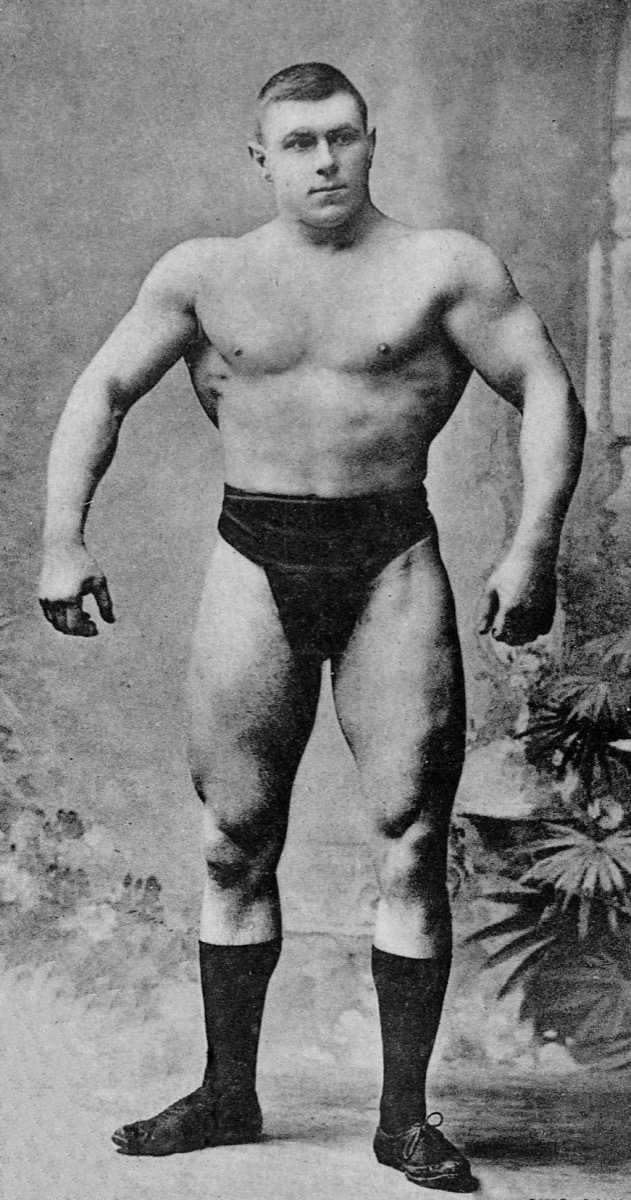
Georg Hackenschmidt ("the Russian Lion"), ca. 1905. Wikimedia Commons, public domain.

By the 1930s and 1940s, training benches with vertical uprights became common in commercial gyms, and the supine press (later called the bench press) joined the curl, the press, and the squat in standard programs. It was still treated as an upper-body assistance lift to the Olympic press, not as a primary movement. The Olympic press — pressing a barbell overhead from the shoulders without leg drive — was the prestige test of upper-body strength all the way through to the 1972 Munich Olympics, where it was finally removed from weightlifting because judges could not consistently distinguish a strict press from a layback push press.
The bench press inherited that vacancy.
Pat Casey, an American powerlifter, became the first man to bench 600 lb (272 kg) in the late 1960s, a number that earlier had seemed almost mythical. Casey was also the first man to total 2,000 lb across squat, bench, and deadlift, and he basically defined what a heavyweight powerlifter looked like for a generation. The first AAU Senior Nationals in 1964 used the bench press as one of three competition lifts, and when the IPF formed in 1972 the bench was locked in alongside the squat and deadlift as the canonical three.
The next forty years split into two parallel histories.
Equipped lifting went down the road of specialized fabric. In 1985 John Inzer introduced the Inzer Power Shirt — a tight single-ply polyester top that, when stretched at the bottom of a bench press, stored enough elastic energy to pop the bar off the chest. The first generation added 10–25 kg to a maximal lift. Within a decade, denim and canvas constructions came along, then double-ply, then triple-ply Inzer Rage X and similar shirts, until equipped benches were adding 100–200 kg to a lifter's raw number. Anthony Clark became the first man to bench 800 lb (363 kg) in equipped competition in 1997. Ryan Kennelly broke 1,000 lb (454 kg) in 2008, eventually pushing the all-time record to 1,075 lb (487.6 kg). Jimmy Kolb, the current dominant equipped bencher, has pushed the all-time record above 700 kg / 1,540 lb in multi-ply. At those weights the bar movement off the chest is essentially passive — the shirt does most of the work in the bottom half — and the lifter's job is to lock out a weight no human could otherwise stabilize. Equipped bench is its own sport.
Raw lifting had a parallel and quieter history until the late 2000s, when a backlash against equipped specialization produced "raw" classes in most major federations. The records that followed were entirely on the lifter:
- Bill Kazmaier, in 1981, hit a 300 kg bench in IPF competition with only wrist wraps — the first man verifiably above the 300 kg raw barrier.
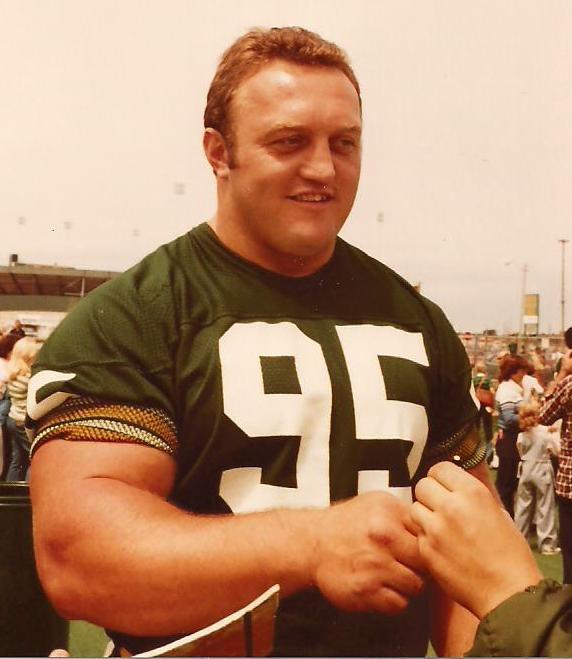
Bill Kazmaier in 1981, the year of his 300 kg IPF raw bench. Photo by WI Connection, Wikimedia Commons, CC BY-SA 3.0.

- Eric Spoto put up 327.5 kg (722 lb) in 2013 at a non-IPF meet under raw-with-belt-only rules. That was the modern raw record for years.
- Kirill Sarychev, the founder of WRPF, hit 335 kg (738.5 lb) at the WRPF World Cup in Moscow, 2015.
- Julius Maddox, an American super-heavyweight, took the raw record to 355 kg (770.5 lb) at WRPF Heavy Hitters in December 2020. Maddox has attempted 363 kg (800 lb) multiple times since without success, and the 800 lb raw bench remains an open question — possibly the highest unmet symbolic barrier in strength sport.
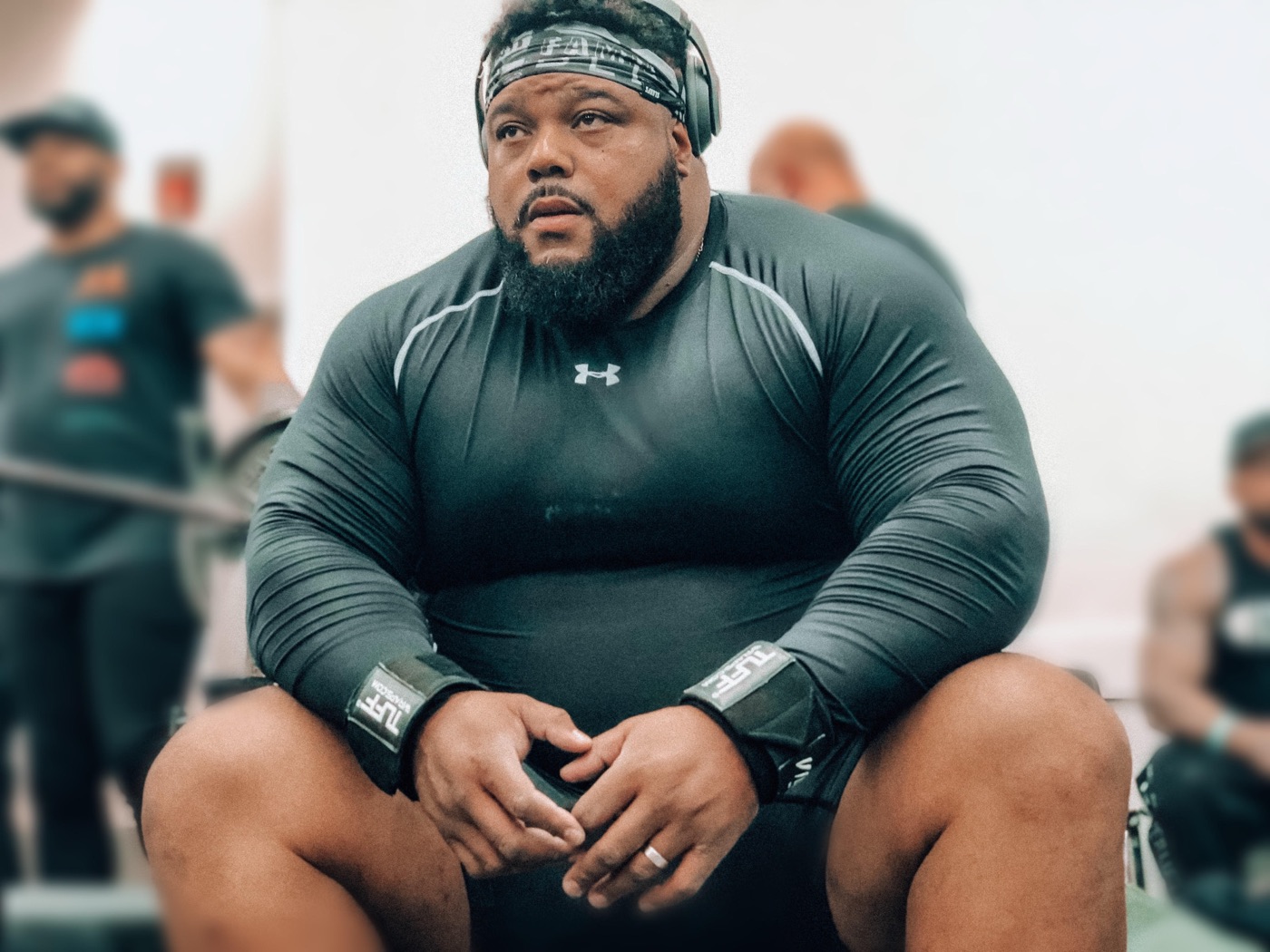
Julius Maddox in the warm-up room before his 770 lb / 350 kg world-record bench, Arnold Sports Festival, March 2020. Photo by Julius Maddox, Wikimedia Commons, CC BY-SA 4.0.

Women's raw bench evolved later than men's but along the same curve. Jennifer Thompson, an IPF lifter who competed across nearly two decades in the 84 kg and below classes, set raw bench records that for years sat well above what was thought possible at her bodyweight, eventually pushing past 142 kg in raw competition. Modern super-heavyweight women like Sonita Muluh and Bonica Brown have moved the women's IPF bench records well past 180 kg raw and 200 kg equipped.
These records exist for calibration, not mythology: the men's raw ceiling sits around 355 kg with 800 lb still pending, the women's raw ceiling at the largest bodyweights is approaching 200 kg, and the equipped numbers continue to drift upward in their own parallel sport. None of them are settled.
Setup: the part everyone underestimates
A casual gym lifter sets up a bench press in three seconds. A national-team powerlifter takes thirty. The difference is not theatrics — almost the entire bench press is decided before the bar leaves the rack.
The five points of contact required by the IPF and most other federations are: head, shoulders, hips, left foot, right foot. Every one of them serves a mechanical purpose.
- Head and shoulders on the bench anchor the upper body so the spine can transmit force from the legs through the pressing platform.
- Hips on the bench define the legality boundary; lifting the hips is a red light in every major federation.
- Both feet flat on the floor (in the IPF; some federations allow feet on the bench, with mechanical consequences) provide a base of force production for leg drive.
The order of operations that competitive lifters use:
- Eye line under the bar. Slide up or down until the bar is roughly above the eyes; this leaves clearance for unracking without dragging the bar through the J-cups.
- Pull the shoulder blades back and down. Retract the scapulae together and depress them toward the hips. This creates a tight, stable pressing platform on the upper back. A flat or shrugged scapula is the single most common cause of shoulder pain on the bench.
- Set the arch. Drive the upper back into the bench, plant the feet, and use the legs to pull the body up the bench so the lower back lifts off the pad. The arch should come from thoracic extension, not lumbar hyperextension; if your lower back is doing the work, you are about to hurt it.
- Plant the feet. Either flat with the heel down (IPF style) or up on the toes (some federations, more leg drive). Feet should feel rooted, not floating.
- Grip and unrack. Take the grip first, get tight, then unrack with the help of a hand-off. The hand-off is not optional at heavy weights — coming out of the J-cups with a heavy bar by yourself wrecks your scapular position.
Once the bar is over the chest, the lifter takes a breath, braces, and waits for the start command if competing. From this point forward the bench is a question of how well the setup holds.
Grip width, the arch, and the foot position triangle
The three big technique decisions a bench presser actually makes — grip width, arch height, foot position — interact with each other in a way that matters more than any one of them individually.
Grip width. The IPF caps the grip at 81 cm between the index fingers (measured to the marked rings on competition bars). Most strong lifters take a near-maximum grip because a wider grip shortens the bar path. Narrower grips put more emphasis on the triceps and stress the shoulders less. A reasonable starting heuristic: take a grip wide enough that, at bar-on-chest position, the forearm is vertical and the elbow sits roughly under the wrist. From there, move out by a finger-width per session if the goal is competition strength, or in by a finger-width if the goal is shoulder-friendly hypertrophy.
The arch. Federation rules let you arch as much as your spine and hip mobility allow, provided the hips stay on the bench and the shoulders stay in contact. Arching does three useful things at once: it shortens the bar path by raising the chest, it improves leverage by tilting the trunk slightly, and it lets the lats and the pecs work in a more advantageous angle. Extreme arches — the kind you see on YouTube where the lifter looks folded in half — require both significant thoracic extension and a relatively short torso, and they're not available to most adults who didn't gymnastics-train as children. A moderate arch built from thoracic extension is universally available and adds 5–15% to most lifters' top-end strength. The competitive ceiling on arching is mostly anatomy.
Foot position. Two camps. The IPF-style flat-foot setup keeps both feet flat on the floor, often turned out, with leg drive coming from pressing through the floor against a tight arch. The "feet up high" setup, used in some non-IPF rules and informally in training, puts the toes up against the bench legs, which generates more leg drive at the cost of some stability. Within IPF rules, the choice that matters is whether you press through the heel (more vertical force, locks in the arch) or through the ball of the foot (more horizontal drive into the upper back). Most strong IPF lifters press through the heel.
The interaction: a wide grip, a high arch, and a strong heel drive favor the bottom of the lift. A narrower grip, a flatter arch, and a more vertical foot favor the top of the lift. There is no single correct combination — it depends on whether your sticking point is on the chest, mid-press, or near lockout, and on your leverages.
The pause, the press, and what gets red-lighted
The IPF requires a visible, motionless pause of the bar on the chest. The judging sequence is: lifter unracks, bar lowers to chest, bar comes to a complete stop on the chest (the head judge calls "press" when satisfied), the bar is pressed to lockout with elbows fully extended (head judge calls "rack"), the lifter racks the bar.
The lifts that get red-lighted in competition almost always fall into one of these:
1. Hips off the bench. Driving the hips up to use them as a fulcrum is the single most common red light. The IPF and most federations call this immediately. It usually happens to lifters who built their bench technique in the gym without paying attention to the hip rule.
2. Heaving the bar off the chest. The bar must come to a complete stop. A bar that visibly bounces or sinks-and-rebounds without pausing fails the press command — sometimes the head judge gives the press command anyway because they did not see the bounce, and the side judges red-light the lift.
3. Uneven lockout. Both elbows must lock fully. A bar that locks one side first and finishes the other side late is two red lights in IPF. This is usually a side-to-side strength imbalance and is fixable with single-arm dumbbell work.
4. Downward motion before the rack command. Once the bar is locked out, it has to stay locked until the head judge says "rack." Lifters who relax slightly before the command — letting the bar drift down even a centimeter — get red-lighted. Holding lockout for a full second longer than feels natural is the standard fix.
In training, the pause is the thing that translates competition. Touch-and-go bench is fine for hypertrophy and for total volume, but the strength to break the bar off the chest from a dead stop is a specific skill that has to be trained specifically. Any program built for competition has paused work as the primary bench-press variation.
Four ways the bench press goes wrong
Most missed bench presses fail in one of these patterns. Recognizing them quickly saves both the lift and the shoulder.
1. Chest collapse / lost arch. The lifter loses the arch on the descent — usually because the lats relax — and the bar drops onto a soft chest with the elbows flared. The press from there is a near-vertical push from a disadvantaged position, and the bar stalls in the bottom third. Cause: poor scapular position or bracing failure. Fix: paused bench at moderate weight focusing on holding the arch, plus heavy rows and face pulls to build the back strength to maintain position.
2. Elbow flare. The elbows go out wide (close to 90 degrees from the torso) on the descent, putting the shoulder in a vulnerable internal-rotation-plus-horizontal-abduction position. This is both a strength leak — wider elbows mean longer moment arms at the shoulder — and the single biggest predictor of pec and shoulder injuries on the bench. Cause: pulling the bar down with the upper pec instead of tucking it with the lats. Fix: cue "elbows toward hips" on the descent, train spoto press or pin press to a lower-than-touch height, build lat strength.
3. Forward bar drift. The bar moves over the face on the press, ending up over the throat or chin at lockout instead of over the shoulder. This is mechanically inefficient — the lifter is pressing into a longer moment arm than necessary — and it's how lifters get pinned and need a spotter. Cause: pressing straight up from the chest instead of pressing slightly back toward the rack. Fix: practice the J-curve bar path with submaximal weights, focus on driving the bar back into the start position rather than straight up.
4. Stall mid-press. The bar moves off the chest fine, stalls 5–10 cm above it, and the press fails. This is a tricep weakness combined with a transition problem — the lifter had momentum off the chest from leg drive and arch, lost it, and the triceps were not strong enough to finish. Cause: tricep-limited lockout, or a setup that stored too much elastic energy at the bottom and not enough strength in the middle. Fix: close-grip bench, board press, JM press, dedicated tricep work.
Bracing on the bench: not the same as the squat
Bench-press bracing is different from squat bracing. The squat needs 360-degree intra-abdominal pressure to keep the spine rigid under axial load; the bench needs a stable pressing platform on the upper back plus enough trunk pressure to keep the arch from collapsing.
The cue most coaches use: take a big breath into the chest and the belly together, tighten the lats by imagining "bending the bar toward the hips" before unracking, drive the upper back into the bench, and hold the breath for the entire rep. Exhale only at lockout if at all — many strong benchers exhale only between reps.
The Valsalva maneuver — closed glottis, breath hold, brace — applies to the bench just as much as to the squat. It produces a brief blood pressure spike that matters for lifters with uncontrolled hypertension or known cardiovascular disease and matters approximately not at all for healthy adults.
A belt is less universal on the bench than on the squat. Some lifters wear one to give the abdominal wall something to push against and to stabilize the arch; others find a belt cuts into the diaphragm in the arched position and skip it. The decision is individual. Belt or no belt, the fundamental requirement is that the trunk stays rigid from the moment of unrack to the moment of rack.
Programming: how often and how heavy
The bench press recovers faster than the squat or the deadlift for almost everyone. The trunk and the legs do not take meaningful damage on a bench-press session, the muscles involved are smaller, and the joints — when technique is good — are not loaded in a way that requires multi-day recovery. This is why high-frequency bench programming works so well for so many people.
A reasonable progression:
-
Beginner (first 6–12 months). Bench 2–3 times per week, linear progression, +2.5 kg per session as long as form holds. Stop adding weight the moment the elbows start flaring or the bar starts drifting forward. Realistic year-one progress varies a lot with starting strength, body composition, and recovery, but a typical range for adult men is reaching a bodyweight bench (around 70–90 kg for a 80 kg lifter) within the first year. For women the corresponding range is roughly 0.5–0.8 of bodyweight, with significant individual variation driven by upper-body proportions.
-
Intermediate. Bench 2–4 times per week, mix one heavier paused session with one or two volume sessions. Start adding variations: close-grip bench, larsen press (legs up, no leg drive), spoto press (paused 5 cm above chest), incline press. Linear progression stops working; switch to weekly waves or block periodization.
-
Advanced. Bench 3–6 times per week, with at least one variation per week and a competition-specification paused session as the primary day. Periodize in 4–8 week blocks. The bench shirt or non-shirt distinction starts mattering for programming — equipped lifters need shirt sessions interleaved with raw work because the groove is genuinely different.
The Sheiko, Smolov Jr., and Russian Squat-style programs all use frequencies of 3–4 bench sessions per week as their base assumption, and the empirical record over forty years suggests this is approximately optimal for raw intermediates. Lifters who try to do everything in one heavy bench day per week tend to plateau early.
Equipment: what actually helps
Strip away the marketing and there are four pieces of bench-specific equipment that affect performance.
Wrist wraps. Stiff cotton-elastic wraps around the wrist, 50–60 cm long. Used correctly, they keep the wrist neutral under the bar and prevent the bar from rolling back into the heel of the palm at heavy weights. The strength effect is small but the joint protection is meaningful — almost every serious bencher uses them above 80% of max. Allowed in raw federations.
Belt. A 10 mm or 13 mm leather belt, lever or prong. On the bench it serves a different purpose than on the squat: it gives the trunk something to brace against and helps maintain the arch. Effect on weight is modest (2–5%) and individual; some strong benchers prefer no belt because the diaphragm position in a high arch makes a belt uncomfortable.
Bench shirt. Polyester, denim, canvas, or Inzer Rage X-style multi-ply. A purpose-built piece of competition equipment for equipped lifting only. Adds anywhere from 25 kg (entry-level single-ply) to 200 kg+ (well-broken-in multi-ply) to a maximal lift. Requires multiple training partners to put on, generates serious bruising, and creates a completely different lift than the raw bench. Specialized equipment for equipped meets only.
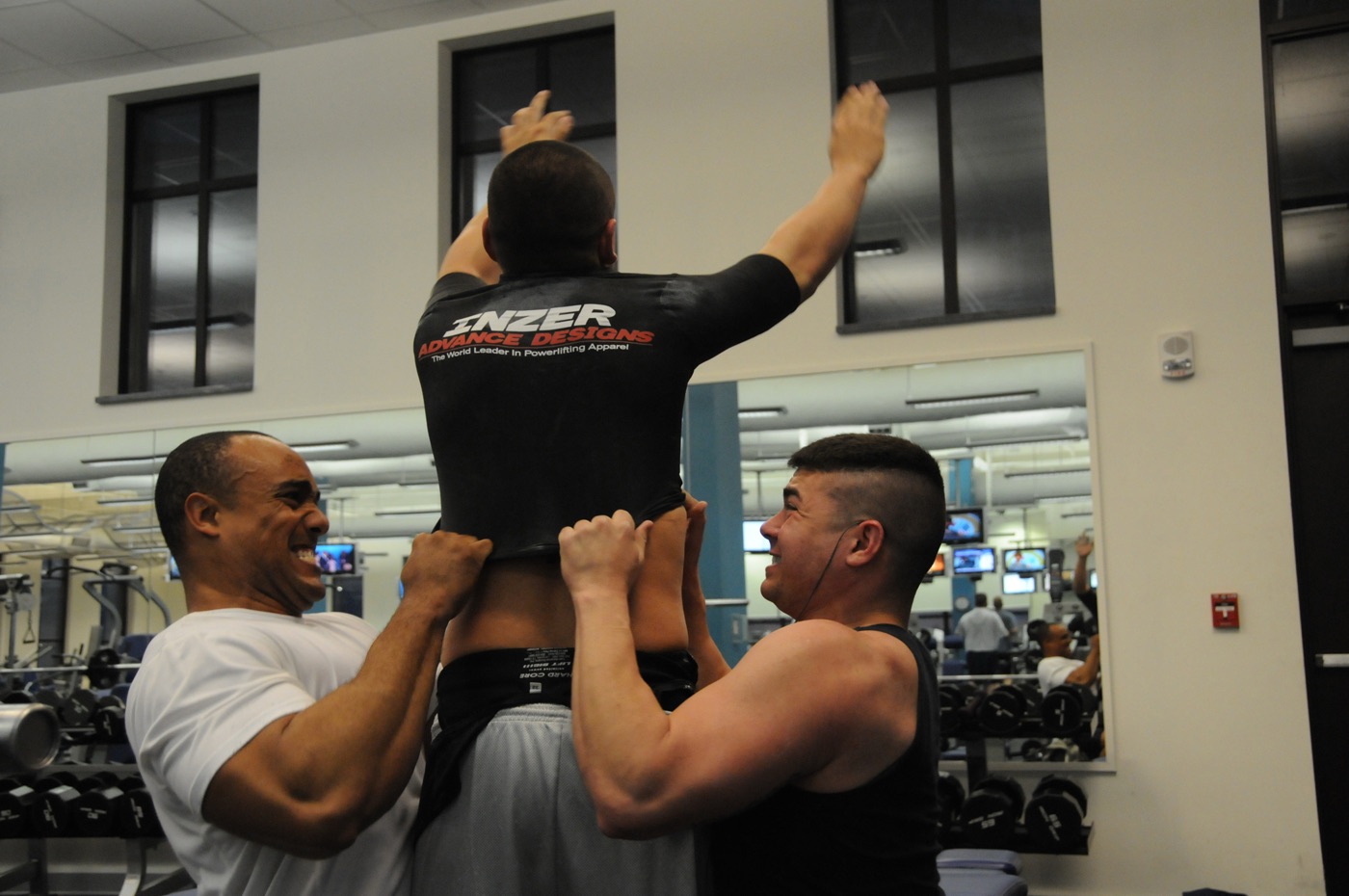
Fitting an Inzer bench shirt — note that two people are needed just to get the shirt on. The garment is so tight at the bottom of the lift that it stores elastic energy and rebounds the bar off the chest. US Air Force, Lajes Field, Azores, 2009. Photo by Tech Sgt. Rebecca F. Corey, Wikimedia Commons, public domain (US federal government work).

Slingshot / reactive arm bands. A nylon-and-elastic loop worn on the upper arms that adds elastic assistance off the chest. Used in training as an overload tool — you can spoto-press 105–115% of your raw max in a slingshot — but not legal in most competition. Useful for advanced lifters working on the lockout portion of the lift.
If you don't compete, the entire useful equipment list is wrist wraps and a belt. Everything else is either training-specific or competition-specific to equipped meets.
How strong is "strong"
Numbers without context are useless. The honest version is that we have good data only on lifters who actually competed — OpenPowerlifting aggregates millions of competition results from federations worldwide, but it has nothing on the recreational lifter who has never entered a meet. So the table below is not "novice / intermediate / advanced" by training age. It is percentiles of competing lifters, sex- and bodyweight-matched, computed from each lifter's lifetime-best meet bench.
The numbers below come from a direct calculation over the OpenPowerlifting CSV (2.27 million meet rows, dataset snapshot December 2025). Bodyweight bands are 87.5–92.5 kg for the "90 kg male" column and 57.5–62.5 kg for the "60 kg female" column. Each lifter is counted once, at their lifetime best.
Raw (sleeves only) — what most modern lifters compete in:
| Percentile of competing lifters | 90 kg male bench | 60 kg female bench |
|---|---|---|
| 10th percentile | 102.5 kg | 40.0 kg |
| Median (50th) | 137.5 kg | 55.0 kg |
| 75th percentile | 155.0 kg | 65.6 kg |
| 95th percentile | 185.0 kg | 85.0 kg |
| 99.9th percentile | 235.3 kg | 127.7 kg |
| Sample size (lifters) | 39 686 | 15 572 |
Equipped (single- and multi-ply combined) — historically a separate sport with very different ceilings:
| Percentile | 90 kg male bench | 60 kg female bench |
|---|---|---|
| 10th | 95.2 kg | 36.3 kg |
| Median | 145.0 kg | 55.0 kg |
| 75th | 172.5 kg | 72.5 kg |
| 95th | 218.0 kg | 102.1 kg |
| 99.9th | 310.5 kg | 160.0 kg |
| Sample size | 39 366 | 12 953 |
Three things to read into these numbers:
- The bench press percentile distribution is flatter than the squat. The 10th-to-95th percentile gap for a 90 kg male raw squatter is about 105 kg; for the bench it is about 82 kg. The bench responds less to training and more to leverages and bodyweight. A short-armed lifter with a barrel chest will outbench a long-armed lifter at the same training age and the same bodyweight, every time.
- The right tail is fat in the equipped column and only modestly fatter than the left tail in the raw column. The gap between the 95th and 99.9th percentile in the equipped 90 kg M column is about 90 kg; in the raw column it's about 50 kg. This is a measurement of the shirt, not the lifter.
- The "median competitor" is already a heavily selected population. A lifter who has never competed and benches 130 kg at 90 kg bodyweight is doing well by any reasonable standard, even though they would land below the median of the competition distribution.
For your own percentile against the live distribution — sex, bodyweight, equipment, federation — use the strength percentile calculator. It pulls from the same dataset and gives an exact rank.
What the bench press does that other lifts don't
The bench is sometimes treated as the least serious of the three competition lifts — squat is for legs, deadlift is for grit, bench is for the gym bros. That framing is wrong on the technical side. The bench occupies a genuine and irreplaceable spot in upper-body strength training because of:
- Heavy upper-body load with a stable base. Of all the upper-body pressing variations — overhead press, dumbbell press, push press — the bench is the only one where the load is decoupled from balance demands. That means the lifter can train pressing strength close to its maximum without the lift collapsing for non-pressing reasons (loss of balance, trunk fatigue, etc.).
- High training frequency tolerance. The bench recovers faster than overhead pressing for almost everyone, partly because the shoulder is in a more supported position and partly because the load can be moved without the lower body being involved. This makes it the best upper-body lift for accumulating high volume.
- Direct measurability. Unlike the overhead press (where some federations allow leg drive and some don't, and rules vary), the bench has near-universal rules: hands inside the marks, hips on the bench, pause on the chest. A 200 kg paused bench means almost the same thing in 1985 as it does in 2026.
- Skill transfer to other pressing movements. Training the bench improves close-grip bench, dips, overhead press, and the lockout of the deadlift (via lat tightness). The reverse transfer — overhead press to bench, dips to bench — is real but smaller.
That bundle of properties is why the bench has held its place as one of the three competition lifts in powerlifting for sixty years and why it remains in nearly every serious upper-body program even outside competitive lifting.
Common gym wisdom that is wrong
A short list of claims that get repeated forever and are mostly or entirely false. If you only read one section of this article, this is the one with the highest decision value.
"Arching is cheating." No. Arching is explicitly legal in IPF, WRPF, USAPL, and every other major raw federation, provided the hips stay on the bench. The arch shortens the bar path within the rules — it is a skill that flexible lifters use to lift more weight, not a rule violation. Lifters who refuse to arch on principle leave 5–15% of their potential bench on the table, and usually have worse shoulder positions on top of it.
"Bench press is bad for your shoulders." Inverted. Bench press with bad form — flared elbows, no scapular retraction, no lat engagement — is bad for shoulders. The bench press performed with proper scapular position is one of the safer pressing movements available, because the bench supports the shoulder in retraction throughout the lift. Lifters who get hurt benching are almost always lifters who were not setting up correctly.
"You should bench with your feet up to isolate the chest." Mostly false. Feet-up bench (sometimes called larsen press) is a useful training variation because it removes leg drive and exposes upper-body weakness, but as a default technique for a strong lifter it leaves a meaningful amount of weight on the bar. Leg drive is legal in every major federation and adds 5–10% to the lift; refusing to use it is a choice, not a rule.
"Your bench will go up if you bench more." Partly true, partly the most overrated advice in lifting. The bench responds well to volume up to a point, but for intermediates and beyond the limiter is rarely the bench itself — it is the back, the triceps, or the technical position. Lifters stuck at a bench number for months almost always need to row more, not bench more. Upper-back thickness is the foundation of a stable pressing platform, and most stuck benchers have weak upper backs.
"Touch-and-go bench is the same as paused bench." False. The stretch reflex in the pec at the bottom of a touch-and-go contributes meaningfully to the press — anywhere from 5 to 10% of the lift, depending on the lifter and the speed. A paused bench eliminates this and tests pure starting strength. Lifters who only train touch-and-go and then compete in a paused federation routinely miss their planned openers.
"Bench shirts will hurt you / make your raw bench worse." Both false. Bench shirts are a piece of equipment for a different version of the sport. They do not hurt raw bench when used in a separate training cycle, and they do not damage the lifter when used correctly. They are also not transferable: a 1,000 lb shirted bench tells you almost nothing about the lifter's raw bench. Equipped and raw are two parallel sports.
"Tall lifters can't bench heavy." Wrong on average and very wrong as a rule. Long arms make the bench harder, but they do not cap it. Several of the strongest equipped benchers in history have been tall lifters (Ryan Kennelly was over six feet); strong raw benchers tend to be shorter and barrel-chested but the distribution overlaps. Body proportions matter, but the ceiling on a tall lifter's bench is set by training and time under the bar, not by inches of femur.
A short checklist before your next bench session
- Setup is locked in: head, shoulders, hips, both feet planted before the unrack
- Scapulae are retracted and depressed, not floating
- Arch is built from thoracic extension, not lumbar hyperextension
- Wrist wraps on for any working set above 80% of max
- Bar is unracked with a hand-off if available; never with a heavy weight on a personal record attempt
- Hold the breath through the full rep; exhale only at lockout if at all
- Pause one set per session if competing in a paused federation; skip the bounce
- Film one set per session from the side: bar path, elbow position, hip contact
- Track the numbers; intuition across weeks is unreliable
Where to go next
- Compare your bench against the live distribution in the strength percentile calculator.
- Train the other two competition lifts: the squat and the deadlift.
- Read about how the overhead press compares to the bench as an upper-body strength test.
- For programming context, see powerlifting training methodology.
- For the political and rule-set context the bench standards live in, see the federations article.
If you find specific claims in this article you can falsify with data — record citations, federation rule changes, biomechanics references — open an issue or send a message. Corrections welcome and they get applied.